A walk-in cooler that will not stay at 41°F almost always has one of a short list of causes: warm air getting in at the door, an iced evaporator, a defrost or drain fault, a condensing unit that cannot shed heat, low refrigerant, or a box loaded so the air cannot move. Here is how to tell which.
Why is my walk-in cooler not holding temperature?
A walk-in that will not hold 41°F usually has one of six causes: warm air getting in at the door, an evaporator coil iced over, a defrost or drain fault, a condensing unit that cannot get rid of heat, low refrigerant, or product packed so tight the cold air cannot move. Start at the door and work inward. The first three are the most common.
Key Takeaways
- Read the thermometer in the warmest part of the box first. The FDA Food Code and Louisiana both draw the cold-holding line at 41°F.
- Check the door before anything else: a torn gasket, a closer that does not pull it shut, or a missing strip curtain lets warm, wet air in all day.
- Ice on the evaporator coil is a symptom, not the cause. It points to humid air getting in, a failed defrost, a stopped fan or low refrigerant.
- A condensing unit with a dirty coil, no shade or no room to breathe cannot shed heat, and Baton Rouge summers make that worse.
- Low refrigerant means a leak. Only an EPA-certified technician can open the system.
- Hot food going straight in, and boxes stacked against the coil, can push a healthy box over the line.
Baton Rouge is a hard place to keep a box cold. NOAA engineering weather data for Baton Rouge, based on records from 1973 to 1996, counts about 1,735 hours a year above 80°F at the airport. Every one of those hours, the condensing unit is pushing heat into hot air, and every door opening lets wet air into the box.
This guide is the diagnostic side of a walk-in failure: what you see, what it usually means, and what you can safely check yourself. If you want to know what the repair will involve on the bill, we cover that in how a walk-in cooler repair bill is built.
Box reading warm right now? Keep the door shut, move the product that matters most to another cooler, and call. Somebody picks up any hour, any day. Call (225) 772-4703 Book a visit online
What temperature should a walk-in cooler hold?
Before you chase a cause, confirm the problem. A thermometer reading near the door after a delivery can look worse than the box really is.
The 2026 FDA Food Code requires time/temperature control for safety food to be cold held at 41°F (5°C) or less. It also says the sensor in a refrigerated unit belongs in the warmest part of the unit, so read it there, not next to the coil.
Louisiana uses the same number. The Louisiana Department of Health’s operating guidelines for retail food facilities say coolers must keep that food at 41°F or colder, require a numerically scaled thermometer in every cooler and freezer that stores perishables, and recommend a temperature log.
That log is the best diagnostic tool you own. A box that drifts up a degree a day over a week tells a very different story from one that jumped ten degrees overnight. With the reading confirmed, start at the door.
Is warm air getting in through the door?
The door is where most walk-ins lose the fight, and it is the cheapest place to fix. Every gap lets in warm, humid kitchen or outdoor air, and the system has to pull both the heat and the moisture back out.
Door gaskets. A torn, flattened or stiff gasket leaks all day, every day. Natural Resources Canada’s walk-in refrigeration tips give a simple test: close the door on a sheet of paper, and if it slides around or slips out, the seal needs replacing. Try it at several points around the frame, especially the bottom corners.
Door closers and strip curtains. Federal efficiency standards require walk-ins made since 2009 to have automatic door closers that pull the door shut from within an inch of closed. They also need strip doors, spring-hinged doors or another way to limit warm air getting in while the door is open. A closer that has gone weak, or a strip curtain with torn or missing strips, is a repair worth making.
The door left open. Deliveries, a door wedged open with a case of product, or staff walking in and out during a rush all add up. The same Canadian guidance points out that cold air spills out quickly while the door is open, which forces the system to work harder to get back to temperature.
The door frame heater. Freezers, and some coolers, run a low-wattage heater wire around the door frame, so the gasket does not freeze to it. When that heater fails, the door can ice shut or the gasket tears when someone yanks it open, and you are back to a leaking door.
Fix what you find at the door, give the box a few hours, and check the log again. If it is still climbing, look up at the evaporator.
Why is the evaporator coil icing up?
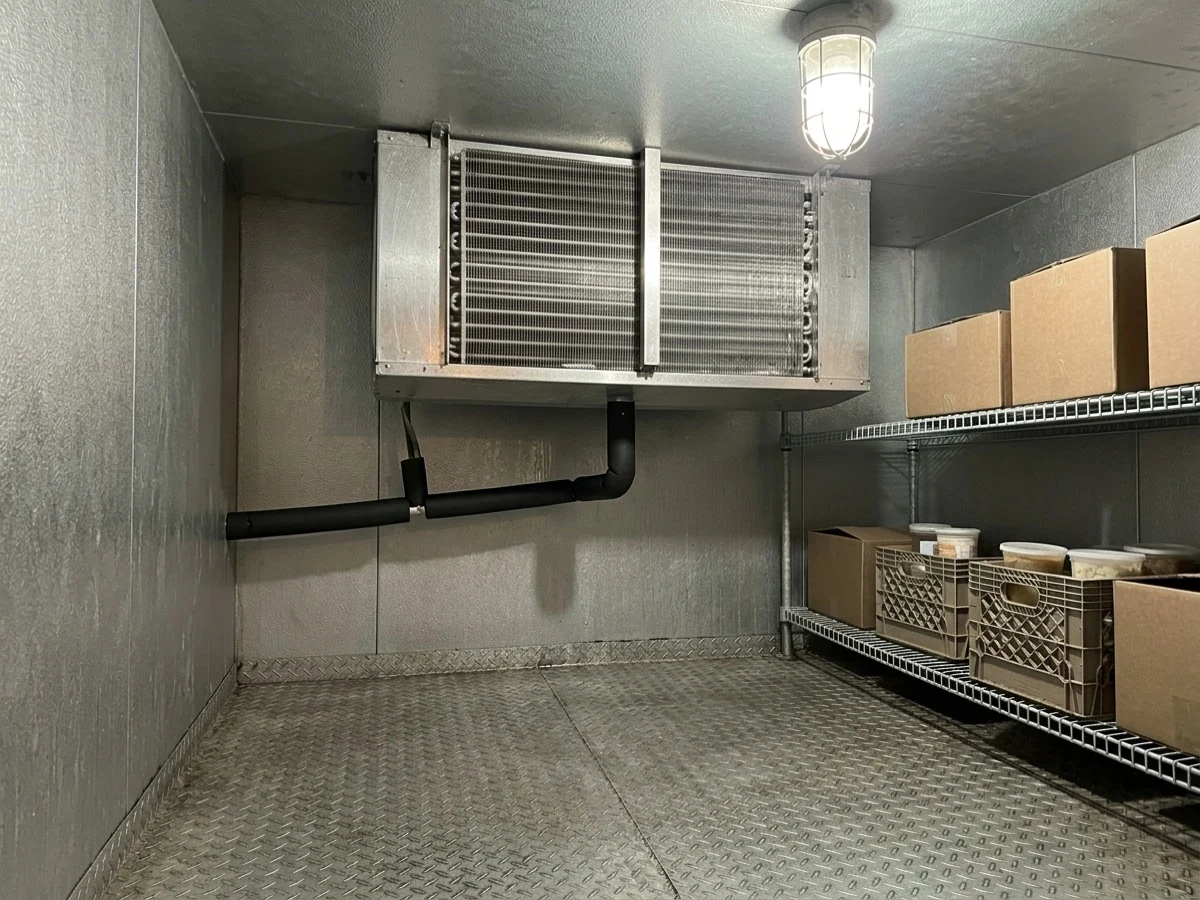
The evaporator is the coil and fan unit hanging inside the box. Its job is to pull heat out of the air. When it ices over, air cannot pass through it, and the box warms up even though the system is running hard.
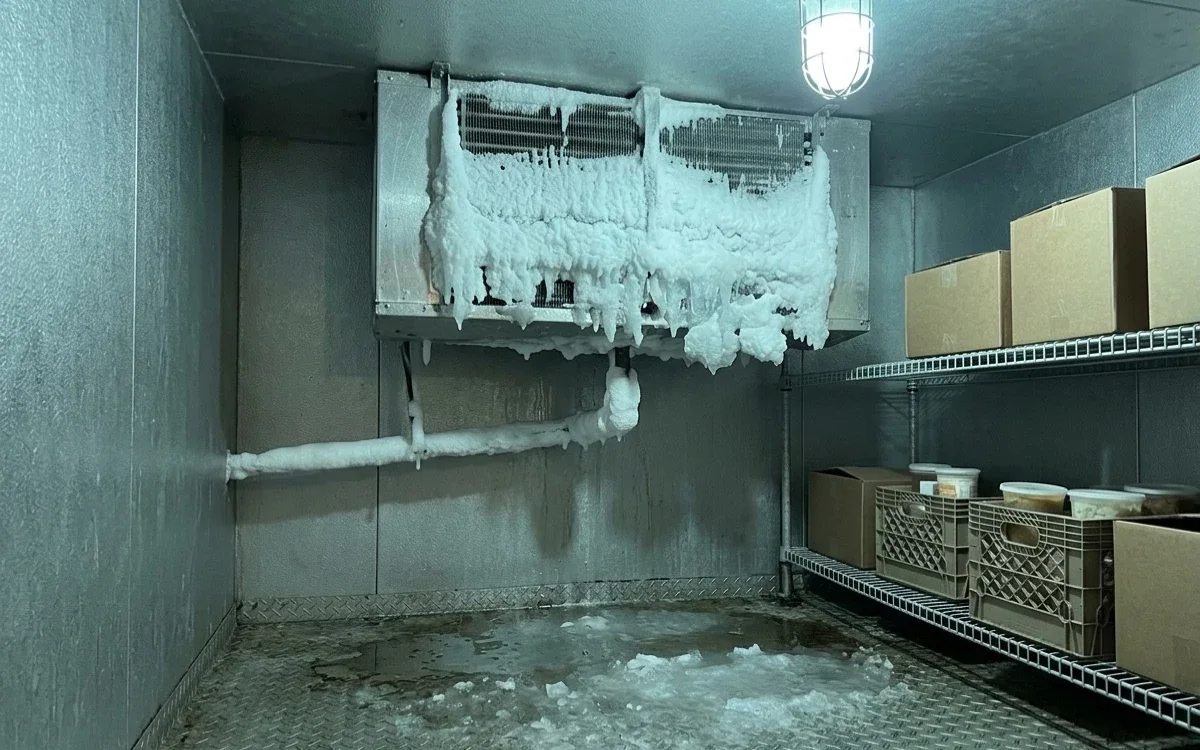
A thin, even frost that clears during defrost is normal. A solid block of ice like the one in the photo at the top of this page is not. Ice on the evaporator is a symptom, and there are four usual causes behind it:
- Humid air getting in. Every leak at the door brings in moisture, and that moisture freezes onto the coil. This is why door problems and ice problems so often show up together.
- A defrost fault. If the defrost cycle is not running, or not running long enough, frost never clears and builds into ice.
- A stopped evaporator fan. With no air moving across the coil, it gets colder and colder until it ices. Walk-ins made since 2009 are required to use electronically commutated or three-phase evaporator fan motors under one horsepower, so a replacement should match that motor type.
- Low refrigerant. A system short on charge runs a colder coil than it should, and ice often starts at one corner or on the suction line before spreading.
Do not chip the ice off with a knife or a screwdriver. The fins and tubes are thin, and a punctured tube turns an ice problem into a refrigerant leak. A technician will thaw the coil properly and then find out why it iced in the first place.
The diagram below shows the five places heat gets into a walk-in, which is the quickest way to think about where to look.
Is the defrost cycle doing its job?
Every walk-in collects some frost on the coil, so every walk-in needs a way to clear it. When that fails, the ice in the last section follows.
Most coolers defrost by switching the compressor off for a while and letting the fans blow box air across the coil. Freezers, and some coolers, use electric heaters on the coil, controlled by a timer or a defrost control. A failed timer, a burned-out heater or a bad termination switch can each stop the cycle, or let it run too long and warm the box.
The drain line matters too. Defrost melts the frost into water, and that water has to leave the box through the drain pan and drain line. When the line clogs, or freezes in a freezer where the drain heater has failed, the water backs up into the pan and refreezes on the coil.
Signs worth noting before you call:
- Ice building up on the coil a little more each day.
- Water dripping from the evaporator or puddling on the floor below it.
- Ice forming in the drain pan or along the drain line.
- The box warming up at the same times every day, which can point to defrost running too long.
Write down what you see and when. Combined with the temperature log, that tells a technician most of the story before the panel comes off.
Ice on the coil, or water on the floor? Leave the ice alone and call. Tell us what the thermometer reads and what the evaporator looks like, and we will tell you what it sounds like and if it can wait for a daytime visit. Call (225) 772-4703 Request an appointment
Can the condensing unit get rid of the heat?
Everything the evaporator pulls out of the box has to be dumped outside by the condensing unit. If that unit cannot shed heat, the whole system loses capacity, and the box drifts up on the hottest afternoons first.
A dirty condenser coil. This is the most common outdoor cause. Natural Resources Canada advises cleaning the condenser coils and fan regularly, because accumulated dust and debris restrict airflow and make the motor work harder. Behind a restaurant, kitchen exhaust grease turns that dust into a sticky mat that a quick rinse will not move.
Sun and heat. The same guidance says to keep outdoor coils shaded, since direct sunlight can overheat them, reduce efficiency and even cause mechanical failure. A unit on a black roof or against a sunny west wall in a Baton Rouge July is working against the weather all day.
Blocked air. Units boxed in by fencing, stored pallets, other equipment or another unit’s exhaust end up breathing their own hot air. Give them room on every side the manufacturer calls for.
What you can do: look at the coil, clear anything stacked around the unit, and note if the box warms up mainly in the afternoon. Cleaning the coil itself, especially with chemicals, is best left to a technician, since bent fins and a wet electrical box are easy to cause.
Could it be low on refrigerant?
Refrigerant does not get used up. A walk-in that is low on charge has a leak, and the leak is the real repair.
Common signs include a coil that ices in one corner or along the suction line, a compressor that runs almost nonstop, and a box that slowly loses ground over days or weeks. None of these prove a leak on their own, which is why gauges and a leak search come before any refrigerant goes in.
This part is not a do-it-yourself job, by law. Section 608 of the Clean Air Act prohibits intentionally venting refrigerants while maintaining, servicing or repairing refrigeration equipment, and technicians who do that work must hold EPA Section 608 certification.
Be wary of topping off the charge with no leak search. It may get the box cold again for a few weeks, and then you are paying for the same visit twice.
Is the box overloaded, or is the air blocked?
Sometimes the system is fine and the box is simply being asked to do too much. This one is free to fix.
Hot food going straight in. A walk-in is built to hold cold food cold, not to chill large batches of hot food. The FDA Food Code sets cooling limits for cooked food: from 135°F to 70°F within two hours, and to 41°F or less within six hours in total. It lists methods that help, such as shallow pans, smaller portions and ice baths, and says containers being cooled should be arranged for maximum heat transfer and loosely covered or uncovered. A stockpot set straight onto a shelf puts all that heat into the box at once.
Air that cannot move. The evaporator needs a clear path to pull air in and throw it across the room. Cases stacked up to the fan, product jammed against the walls and shelves packed floor to ceiling all leave warm pockets, often right where your thermometer sits.
A big delivery. A full truck of product that rode in warm adds heat all at once. Expect a temporary rise. A box that has not recovered after several hours has a different problem.
Leave a few inches of space in front of and around the evaporator, keep boxes off the walls, and cool food before it goes in.
What can you check yourself before you call?
Most of the causes above can be narrowed down in fifteen minutes without opening a single panel. Work through them in this order.
The table below pairs the common symptoms with their usual causes, so you can match what you are seeing.
| What you notice | Most likely cause | What to do now |
|---|---|---|
| Box drifts up slowly over days | Door gasket, closer or strip curtain; dirty condenser coil | Paper test the gasket, check the closer, look at the outdoor coil |
| Solid ice on the evaporator coil | Humid air getting in, defrost fault, stopped fan or low refrigerant | Leave the ice alone and call |
| Water dripping or puddling under the coil | Clogged or frozen drain line, or a defrost fault | Note when it happens and call |
| Box warmest in the afternoon | Condensing unit cannot shed heat: dirty coil, sun, blocked air | Clear around the unit, then book service |
| Compressor runs almost nonstop, box barely holds | Low refrigerant, a dirty condenser, or a door leak | Call for a diagnosis, not a top-off |
| Warm pockets on some shelves only | Product blocking airflow, or hot food loaded in | Clear space around the evaporator and walls |
| Box jumps up after deliveries and recovers | Normal warm load | Keep the door shut and let it recover |
If your symptom lands in the second or fifth row, or the temperature keeps climbing after the door checks, it is time for a technician.
When should you stop checking and call?
Some situations do not leave time to work through a list. Call right away if the box is above 41°F and still climbing, if the evaporator is a solid block of ice, if the fans inside have stopped, or if the compressor is running and the box is getting warmer anyway.
While you wait, keep the door shut, move the product that matters most to a working cooler, and keep logging temperatures. What you keep and what you discard is a decision for your food safety plan, not your refrigeration technician. If you are unsure, your parish health unit can advise.
Our commercial refrigeration service for Baton Rouge restaurants and stores covers walk-in coolers and freezers, reach-ins and prep tables. If the same problem keeps coming back, look at one of our maintenance plans. A scheduled visit is built to catch the slow failures, like a fading gasket or a fouled condenser coil, before they turn into a warm box on a Friday night.
Walk-in cooler temperature questions Baton Rouge operators ask
These are the questions restaurant owners and store managers ask us while standing next to a box that reads warm. For more, our HVAC and refrigeration questions page covers the basics.
Why is my walk-in cooler warm but the compressor is running?
The compressor running does not mean the box is getting cold air. The usual reasons are an evaporator iced over or with a stopped fan, a condensing unit with a dirty coil that cannot shed heat, or a refrigerant leak. A door that leaks all day can also outpace a healthy system. Check the door and the evaporator first.
What temperature should a walk-in cooler be set to?
The FDA Food Code requires time/temperature control for safety food to be held at 41°F or below, and Louisiana uses the same line. Most operators set the box a few degrees colder so it stays under 41°F after door openings. Read the thermometer in the warmest part of the box, not next to the coil.
Why does my walk-in cooler keep icing up?
Ice on the evaporator comes from moisture and a coil running too cold. Warm, humid air getting in at a torn gasket or an open door is the most common source in South Louisiana. A failed defrost, a stopped evaporator fan or low refrigerant can also cause it. Thawing the coil without fixing the cause brings the ice back.
How do I know if my walk-in door gasket is bad?
Close the door on a sheet of paper at several points around the frame. If the paper slides around or slips out, that section is not sealing. Also look for tears, flattened or stiff sections and frost forming along the door edge. A gasket is one of the cheaper walk-in repairs and one of the most common.
Can a dirty condenser coil make a walk-in lose temperature?
Yes. The condenser coil is where the heat from inside the box is dumped outside. When dust and kitchen grease clog it, the system cannot shed heat, loses capacity and runs longer. The box often drifts warmest on hot afternoons. Regular coil cleaning is one of the most useful parts of a maintenance visit.
Can I add refrigerant to my walk-in cooler myself?
No. Under Section 608 of the Clean Air Act, technicians who maintain, service or repair refrigeration equipment must be EPA certified, and venting refrigerant during service is prohibited. A system that is low on refrigerant also has a leak, and adding refrigerant without finding the leak only delays the next warm box.
Walk-in still reading warm? Call Southern Dreams Mechanical. We service walk-in coolers and freezers across Baton Rouge, Denham Springs and Livingston Parish. You get the diagnostic charge up front and a price before any repair starts. Call (225) 772-4703 See our walk-in cooler and freezer service
Last updated November 19, 2026