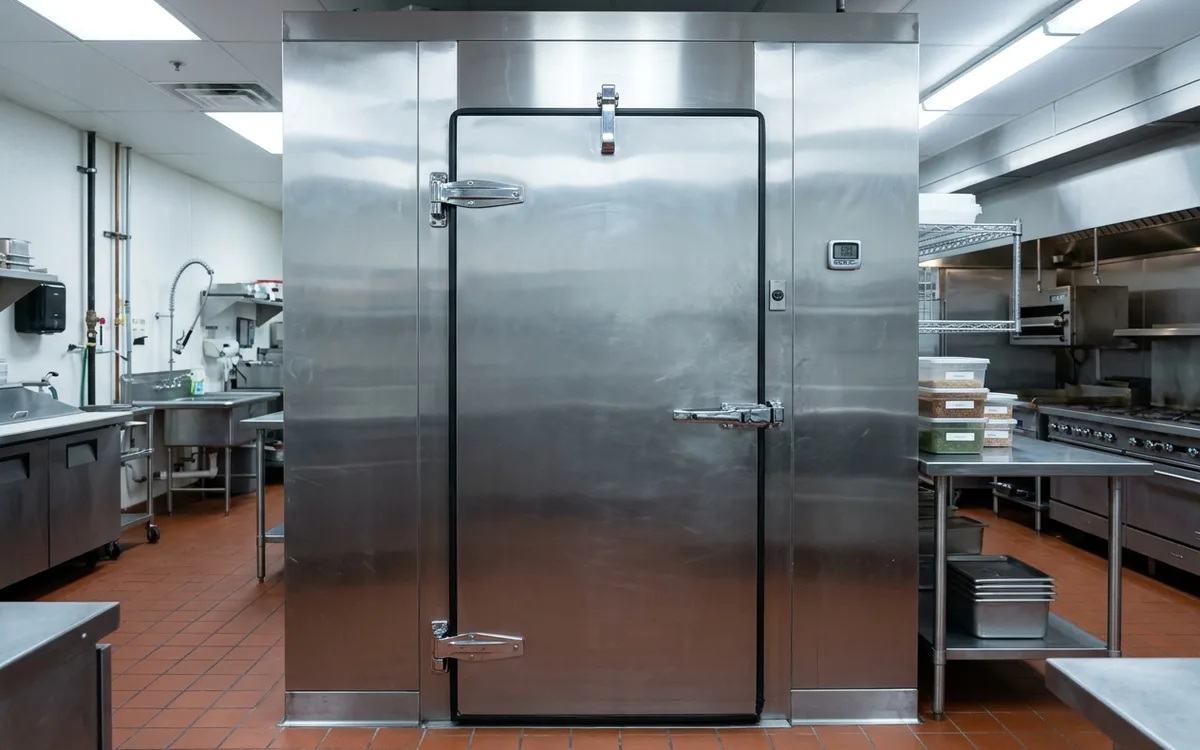
Restaurant refrigeration maintenance splits into three layers: daily checks your staff make, regular cleaning between visits, and a technician's service about every six months. Here is what belongs in each layer, how often, and what the 2026 EPA leak rules mean for your walk-in.
What does preventative maintenance for restaurant refrigeration cover?
Preventative maintenance for restaurant refrigeration has three layers. Staff log temperatures and check doors every day. Gaskets, drains, and the space around coils get cleaned between visits. A technician cleans the condenser and evaporator coils, checks the refrigerant, defrost, fans and controls about every six months, more often in a hot or greasy kitchen.
Key Takeaways
- Refrigeration is the biggest electricity user in a commercial kitchen, at a national average of 44%, according to ENERGY STAR.
- Staff checks are free: a daily temperature log, a door that closes on its own and a gasket that seals.
- Dirty coils are the costliest thing to skip. One study found basic coil cleaning cut energy use by 17% on average.
- About every six months, a technician should clean the coils, blow out the drains and calibrate the controls.
- Ice machines get cleaned on the manufacturer’s schedule, by Food Code rule.
- Since January 1, 2026, EPA leak repair rules cover many commercial systems holding 15 pounds or more of HFC refrigerant.
South Louisiana is hard on refrigeration. NOAA engineering weather data for Baton Rouge, built from records between 1973 and 1996, counts about 1,735 hours a year above 80°F. Add a kitchen exhaust fan blowing grease toward the condensing unit, and a coil can foul fast.
Timing makes it worse. Restaurant volume climbs from late November through December, and a walk-in that fails during your busiest weeks costs the most. That holds for a kitchen in Baton Rouge and for one in Denham Springs. The plan below is built to catch the slow failures first.
Want your coolers checked before the holiday rush? We service walk-ins, reach-ins, prep tables and ice machines. Somebody picks up any hour, any day. Call (225) 772-4703 Book a maintenance visit online
Why does restaurant refrigeration need a maintenance schedule?
Refrigeration runs every hour you are open and every hour you are closed. That makes it one of the biggest lines on your power bill and one of the easiest to let slide.
The ENERGY STAR guide to cutting refrigeration costs in commercial kitchens, published in 2024, cites U.S. Energy Information Administration data showing refrigeration uses 44% of a kitchen’s electricity on average. The same article says clean condenser and evaporator coils and proper airflow are worth almost $1,000 a year for an average food service facility.
Maintenance on a schedule also costs less than waiting for a breakdown. The Department of Energy’s Operations and Maintenance Best Practices Guide, Release 3.0 from 2010, says studies put preventive maintenance savings at 12% to 18% on average over a run-it-till-it-breaks approach. That figure covers building equipment in general, not restaurants alone, but the logic carries over.
The same guide is honest about the limits. Preventive maintenance reduces failures, but it does not end them. Think of it as fewer emergencies and longer equipment life, not a guarantee. The work starts with your own staff.
What should your staff check every day?
The cheapest maintenance happens before the first prep shift, and it takes a few minutes. These checks catch most problems while they are still small.
Log the temperature. The Louisiana Department of Health’s operating guidelines for retail food facilities require coolers to hold perishable food at 41°F or colder, require a thermometer in every cooler and freezer, and highly recommend a temperature log. A log shows a slow drift weeks before the box fails.
Read it in the right place. The 2026 FDA Food Code says the thermometer sensor belongs in the warmest part of a refrigerated unit. A reading next to the evaporator coil will look better than the food really is.
Check the doors. The same Food Code requires equipment parts such as doors, seals and hinges to be kept intact, tight and adjusted to the manufacturer’s specifications. Each morning, confirm every door swings shut on its own and the gasket sits flat with no tears.
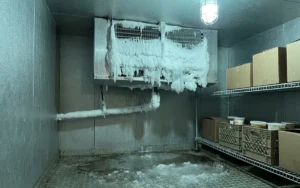
Look up and look down. A thick layer of ice on the evaporator coil, or water on the floor below it, is worth a call that day. So is a fan that has gone quiet or a compressor that never seems to stop.
What should get cleaned between service visits?
Between technician visits, a few cleaning jobs keep the system breathing. None of them need a panel opened or a tool beyond a rag and a flashlight.
Gaskets. The ENERGY STAR article treats gaskets as a housekeeping job for the operator. Food debris and spills grow mold, which makes gaskets stick and tear. It also warns that harsh chemicals, such as bleach mixed too strong, clean the gasket but shorten its life. Use a mild cleaner and a soft cloth.
The seal test. Natural Resources Canada’s walk-in refrigeration tips suggest closing the door on a sheet of paper. If it slides around or slips out, that section of seal is worn out. Try it at several points, including the bottom corners.
Door closers and strip curtains. Federal efficiency standards require walk-ins made since 2009 to have automatic door closers and a way to limit warm air getting in, such as strip doors. Replace torn strips and report a closer that no longer pulls the door shut.
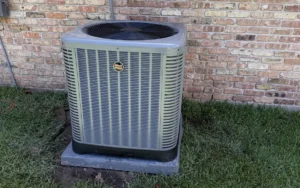
Space around the coils. Keep boxes a few inches back from the evaporator inside the box. Outside, clear pallets, trash and stored equipment away from the condensing unit. The same Canadian guidance says direct sun can overheat outdoor coils, so shade helps too.
Ice machines. The Food Code requires ice bins and ice makers to be cleaned at the frequency the manufacturer specifies, or often enough to prevent soil or mold building up if there is no manufacturer schedule. Keep the manual and follow its schedule.
How often should a technician service restaurant refrigeration?
A good starting point is every six months, then adjust for how hard your kitchen runs. The schedule below pulls the daily, between-visit and technician work into one place.
The ENERGY STAR article includes a maintenance list from a commercial refrigeration service company. It recommends six-month intervals for cleaning evaporator and condenser coils on walk-ins and reach-ins, along with blowing out drains and calibrating thermostats and timers. It also says hotter or greasier kitchens may need more frequent cleaning.
| Task | Who | How often |
|---|---|---|
| Temperature log, read in the warmest spot | Staff | Every day |
| Door closes on its own, gasket sits flat | Staff | Every day |
| Clean gaskets with a mild cleaner | Staff | Regularly, and after spills |
| Paper test on door seals | Staff or manager | Monthly |
| Clear space around coils, inside and outside | Staff | Weekly |
| Clean and sanitize ice machine and bin | Staff or technician | Manufacturer’s schedule |
| Clean condenser and evaporator coils | Technician | About every six months, more in greasy kitchens |
| Blow out drains, calibrate thermostats and timers | Technician | About every six months |
| Check refrigerant pressures and look for leaks | Technician | Every service visit |
If you can only do two things, keep the temperature log and get the coils cleaned on schedule. Not sure where your equipment stands? Our walk-in cooler and freezer service can set the interval after seeing your kitchen. The coils matter most, as the next section shows.
What does a technician do on a scheduled refrigeration visit?
A maintenance visit is not a quick look and a signature. It is a set of measured checks on each piece of equipment, written down, so the next visit has something to compare against.
Coil cleaning. This is the job with the clearest payoff. The ENERGY STAR article describes a 2014 Food Service Technology Center study of 10 units. Basic condenser coil cleaning cut energy use by 2% on a fairly clean coil and by 49% on a badly fouled one, with a 17% average across all 10.
Defrost and drains. The technician confirms the defrost cycle starts and ends as it should and that the drain line carries water out of the box. A drain that backs up refreezes on the coil.
Fans, motors and electrical. Evaporator and condenser fans get checked for noise and speed, and electrical connections get tightened. Door frame heaters on freezers get checked too.
Refrigerant and controls. Pressures and temperatures tell a technician if the charge is right. Thermostats and timers get calibrated, so the box holds the temperature you set.
Ask for the readings in writing. Our guide to what a real tune-up includes explains why a measured visit beats a checkbox, and the same holds for a walk-in. If you would rather have visits put on the calendar for you, our top-tier maintenance plan covers light commercial refrigeration on request.
Coils not cleaned in the last six months? Book a visit, and we will clean them, check the refrigerant and controls, and give you a price before any repair starts. Call (225) 772-4703 Request an appointment
What do the 2026 EPA refrigerant rules mean for your walk-in?
Refrigerant does not get used up. If a system keeps needing more, it has a leak, and since January 2026 more restaurant equipment falls under federal leak repair rules.
The EPA’s January 2026 fact sheet on HFC leak repair explains the rule. From January 1, 2026, owners or operators of appliances holding 15 pounds or more of HFC refrigerant, or certain substitutes, must comply with leak repair requirements. For commercial refrigeration, the threshold leak rate is 20%.
In practice, a leak rate is calculated each time refrigerant is added. If it is over the threshold, the leak must be found and repaired within 30 days, with verification tests afterward. The fact sheet notes it is informational and not a substitute for the regulation itself.
Older systems that still run on ozone-depleting refrigerants have their own EPA leak repair requirements for appliances holding 50 pounds or more, also at 20% for commercial refrigeration. Either way, only a technician with EPA Section 608 certification can open the system.
Ask your technician what refrigerant each unit uses and how much it holds. Keep a record every time refrigerant goes in. Be wary of a top-off with no leak search.
What records should a restaurant keep?
Good records make every service call faster and every repair decision easier. They also show a health inspector you are watching the equipment.
Keep these in one binder or one shared folder:
- Daily temperature logs for every cooler and freezer.
- The readings from each technician visit, by unit.
- Every time refrigerant was added, how much and why.
- Parts replaced, such as gaskets, fan motors and defrost controls, with dates.
- Ice machine cleaning dates and the manufacturer’s recommended interval.
When something does fail, that history shapes the bill. Our guide to walk-in cooler repair costs in Baton Rouge shows how a fault caught early stays a small repair, while the same fault left running can take bigger parts with it.
What can maintenance not prevent?
Maintenance lowers the odds of a failure. It cannot remove them, and it is better to plan for that than to be surprised.
Compressors, controls, and motors still wear out. A power surge, a damaged line or a door left propped open all night can take a healthy box over 41°F. When the temperature climbs, our checklist on why a walk-in is not holding temperature walks through the causes in the order a technician checks them.
Have a plan for that day: a working cooler or ice chest you can move product into, the phone number for refrigeration service posted on the walk-in door, and a clear rule on who decides what product stays and what goes. That decision belongs to your food safety plan.
Restaurant refrigeration maintenance questions Baton Rouge operators ask
These are the questions restaurant owners and kitchen managers ask when they set up a maintenance schedule. For general questions about our work, see our HVAC and refrigeration questions page.
How often should commercial refrigeration be serviced?
A common starting point is every six months. ENERGY STAR guidance includes six-month intervals for cleaning coils, blowing out drains and calibrating controls on walk-ins and reach-ins. Hot, greasy or high-volume kitchens may need visits sooner. Ice machines follow the manufacturer’s schedule.
How often should restaurant condenser coils be cleaned?
About every six months is typical, and sooner near a kitchen exhaust or in a dusty spot. Grease and dust act like insulation on the coil. In one study cited by ENERGY STAR, cleaning cut energy use by 17% on average and by 49% on the dirtiest unit.
What can kitchen staff do between service visits?
Log temperatures daily in the warmest part of each unit. Check that doors close on their own and that gaskets seal. Clean gaskets with a mild cleaner, keep boxes off the evaporator, and clear trash and pallets away from the outdoor condensing unit. Report ice on the coil or water on the floor.
How often should a restaurant ice machine be cleaned?
The FDA Food Code requires ice makers and ice bins to be cleaned at the frequency the manufacturer specifies. If there is no manufacturer schedule, they must be cleaned frequently enough to prevent soil or mold building up. Keep the manual on file and log each cleaning.
Does preventive maintenance actually save money?
Usually, yes. The Department of Energy’s maintenance guide cites studies showing preventive maintenance saves 12% to 18% on average over waiting for failures. For refrigeration, ENERGY STAR puts the value of clean coils and good airflow at almost $1,000 a year for an average food service facility.
Do the 2026 EPA leak rules apply to my walk-in?
They can. Since January 1, 2026, EPA leak repair rules cover many appliances holding 15 pounds or more of HFC refrigerant, with a 20% leak rate threshold for commercial refrigeration. Ask your technician what each unit holds, and keep a record every time refrigerant is added.
Put your refrigeration on a schedule with Southern Dreams Mechanical. We service walk-in coolers and freezers, reach-ins, prep tables, ice machines and beverage systems. You get the diagnostic charge up front and a price before any repair starts. Call (225) 772-4703 Book a maintenance visit online
Last updated November 19, 2026