Should you repair your AC or replace it? Two numbers decide most cases: how old the system is and what the repair costs next to a replacement quote. Here is the decision table we use, the repairs that change the math, and what to check before you buy a new system.
Should you repair or replace your air conditioner?
Use two numbers: the system’s age and the repair cost as a share of a replacement quote. Under about ten years with a first failure, repair almost always wins. Past ten years, once a repair approaches a third of the replacement price, replacing is usually the better value. Past fifteen years with a second or third repair, you are paying for the system twice.
Key Takeaways
- Age and repair cost decide most cases. Repair history and refrigerant type decide the rest.
- Under ten years with a first failure: repair almost always wins.
- Ten to fifteen years: a repair approaching a third of the replacement quote usually points to replacing.
- Over fifteen years with repeat repairs: replace, and plan it before the next failure picks the date.
- An R-22 system with a leak changes the math, because new R-22 has not been made since 2020.
- Before you replace, check the ducts and the sizing. A new system on leaky ducts or the wrong size still underperforms.
A Louisiana air conditioner works harder than most. NOAA engineering weather data for Baton Rouge shows 2,625 cooling degree days in an average year, so a system here racks up long cooling seasons year after year.
That is why the repair-or-replace question tends to arrive in July, under pressure, with a technician waiting for an answer. This guide gives you the table first, then the exceptions, so you can decide before you are standing in a hot hallway.
Weighing a repair against a new system? Estimates on installations and replacements are free. Get the replacement number on paper, then use the table below to compare it with the repair. Call (225) 772-4703 Request a free replacement estimate
What does the decision table say?
Read down to your system’s age, then across to the size of the repair compared with a full replacement quote. To compare, divide the repair price by the replacement price.
| System age | Small part (capacitor, contactor, drain) | Repair well under a third of replacement | Repair approaching or over a third |
|---|---|---|---|
| Under 10 years, first failure | Repair | Repair | Repair, unless the system has failed before |
| 10 to 15 years | Repair | Judgment call: check repair history and refrigerant | Replace is usually the better value |
| Over 15 years | Repair, knowing it buys a season, not a decade | Lean toward replacing, especially after earlier repairs | Replace |
| Any age, R-22 system with a leak | Not applicable | Repair the leak only if it can be found and fixed | Replace |
The thresholds come from how Southern Dreams Mechanical advises customers on its HVAC repair and installation services: past about ten years, a repair approaching a third of replacement cost usually means replacing is the better value. They are a starting point, not a verdict. The next sections cover what moves a case from one cell to another.
Here is the same table as a grid you can read at a glance.
Why does system age matter so much?
Age is a stand-in for two things: how many expensive parts are near the end of their life, and how far behind current efficiency the system has fallen.
Ten years is the line most guidance draws. ENERGY STAR’s heating and cooling guidance says to have equipment evaluated by a professional contractor if it is more than 10 years old or not keeping the house comfortable. If it is not performing efficiently, consider an ENERGY STAR replacement.
The efficiency floor has also moved. Under the Department of Energy’s 2023 standards, split-system air conditioners installed in the Southeast region, which includes Louisiana, must meet at least 14.3 SEER2 below 45,000 Btu per hour. A system installed before 2023 was built to an older, lower standard.
That does not make an old system worthless. It means a repair on it buys less, which is what the table reflects.
The age bands line up with the thresholds in the table.
Which repairs change the math?
Not every repair weighs the same. The type of failure matters as much as the price.
Small electrical parts. A capacitor or a contactor is an inexpensive repair on almost any system. As our equipment sales team puts it, a fixed capacitor on a fifteen-year-old compressor buys you a season, not a decade. Worth doing, as long as you know that.
Refrigerant leaks on an R-22 system. Many older Louisiana systems run on R-22. The EPA’s homeowner guidance on the HCFC phaseout says no new HCFC-22 has been made or imported in the U.S. since January 1, 2020. Only recycled, reclaimed or previously produced refrigerant is available for servicing.
You are not required to replace an R-22 system. But a leak on one means buying from that limited supply, and the EPA asks homeowners to have leaks found and repaired rather than topped off. If the leak cannot be found or fixed, that is usually the end of the road.
Compressor or coil failures. These are the big ones. On a system past ten years, a compressor or coil replacement tends to land in the right-hand column of the table.
Once you know which kind of repair you are facing, the next step is making sure a replacement would actually fix the problem.
Got a repair quote and not sure which column it lands in? Send it our way. We will tell you where it sits on the table, including when repairing is the better buy, even if it costs us the sale. Call (225) 772-4703 Request a free consultation
What should you check before you replace anything?
A new system will not fix a problem that lives somewhere else. Two checks come first.
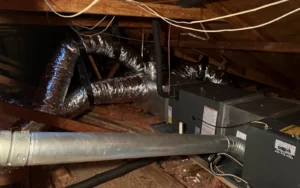
The ducts. ENERGY STAR’s duct sealing guidance says that in a typical house about 20 to 30 percent of the air moving through the duct system is lost to leaks, holes and poor connections. In an attic install, that lost air is cooling the attic. Our ductwork and ventilation service covers testing and sealing.
The sizing and the installation. ENERGY STAR also warns that improper installation can reduce system efficiency by up to 30 percent. Size matters as much as the installation. An oversized system in this climate shuts off before it has run long enough to pull humidity out, so the house ends up cold and clammy.
If a contractor quotes a replacement without looking at the ducts or working out the size the house needs, ask why.
How does repair history shift the answer?
The table assumes a first failure. Repeat failures move you to the right.
Under about ten years with a first failure, repair almost always wins. Past fifteen with a second or third repair, you are paying for a system twice. Between those, it is a judgment call that depends on how often the system has needed help.
Keep every invoice. A written history turns a gut feeling into a pattern you can show a technician, and some manufacturer warranties ask for proof of maintenance anyway.
Regular service also changes how long you get to stay in the left-hand columns. Our guide on how often HVAC should be serviced on the Gulf Coast covers the schedule that catches slow failures early.
How do you pay for a replacement you did not plan?
Most replacements are not planned. A compressor quits in August and the decision has to happen that week.
Southern Dreams Mechanical offers financing through Wisetack on jobs from $500 to $25,000. Any estimate over $500 comes with financing options automatically, and checking what you qualify for does not affect your credit score. The HVAC financing options explain how it works and include a payment calculator.
One change worth knowing if you replaced a system a few years ago. The IRS energy efficient home improvement credit covered qualifying improvements made through December 31, 2025. A system installed now falls after that date, so do not count on that credit in your math.
When will we tell you not to replace?
More often than you might expect. A system under ten years old with a first failure should almost always be repaired, and we will say so.
The same goes for a system whose real problem is ducts, airflow or a drain line. Replacing it would leave the actual fault in place. If maintenance can keep it running well for years, our HVAC maintenance plans are usually the cheaper path.
Repair or replace questions Louisiana homeowners ask
These are the questions worth settling when a quote lands and the system is already old. If yours is not here, our HVAC questions page covers more.
How old is too old to repair an AC?
There is no single cutoff, but age shifts the math. Under about ten years with a first failure, repair almost always wins. Past fifteen years with a second or third repair, replacing is usually the better value. In between, compare the repair cost with a replacement quote and look at how often the system has failed.
What is the rule of thumb for repairing or replacing an AC?
Past about ten years, if a repair approaches a third of the cost of a replacement, replacing is usually the better value. Under ten years with a first failure, repair almost always wins. Get the replacement price in writing, so the comparison is real.
Should I replace my AC if it uses R-22?
Not automatically. The EPA does not require homeowners to replace R-22 equipment, and recycled or reclaimed R-22 is still available for servicing. A leak changes the picture. Have it found and repaired rather than topped off, and if it cannot be fixed, replacing tends to make more sense than refilling.
Can I replace just the outdoor unit on an old system?
Sometimes. The EPA allows owners of existing R-22 systems to replace a broken condensing unit, but the new unit must meet regional efficiency standards. The right call depends on the age and condition of the indoor coil and air handler, so have both inspected before you decide.
Does a new AC fix high humidity in the house?
Only if the old system was the cause. An oversized system short-cycles and never runs long enough to pull moisture out, so a correctly sized replacement can help. But leaky ducts and poor airflow cause the same symptoms, and a new system on the same ducts can feel no better.
Want a straight answer on your system? Southern Dreams Mechanical gives free estimates on replacements and will tell you when repair is the better buy. Get both numbers on paper, then use the table. Call (225) 772-4703 Request a free replacement estimate
Last updated November 19, 2026